
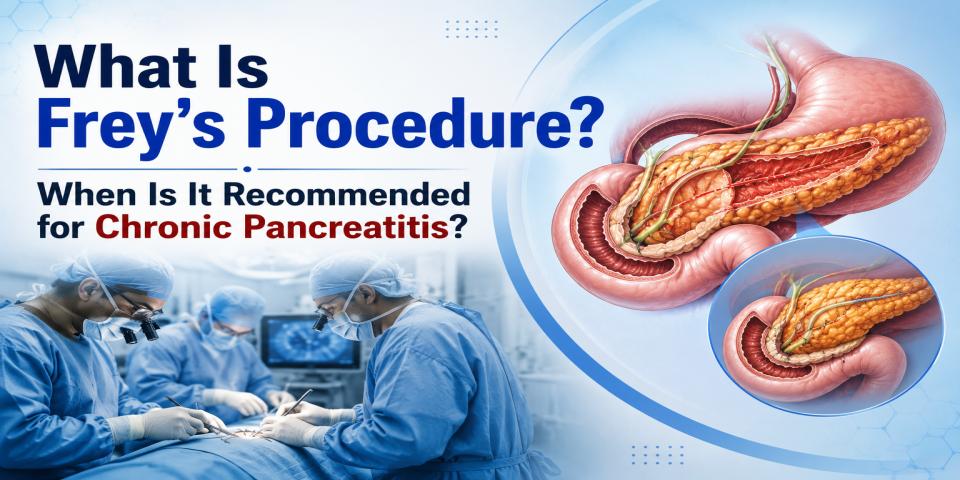
If you or someone in your family has been suffering from chronic pancreatitis — a condition that causes severe, recurring abdominal pain that simply does not go away with medicines — there is a surgical option that most patients in India have never heard of. It is called Frey’s Procedure. Frey’s Procedure in Pune is now available under the expert care of Dr. Manoj Dongare, one of the most experienced HPB surgeons in Pune, who has performed this surgery successfully for patients suffering from long-standing, treatment-resistant pancreatitis. If medicines and endoscopic treatments have failed to give you relief, this blog will help you understand what Frey’s Procedure is, when it is recommended, how it is done, and what recovery looks like — in simple, easy-to-understand language.
What Is Frey's Procedure?
Frey’s Procedure is a specialised pancreatic surgery designed to treat chronic pancreatitis — particularly when the head of the pancreas is enlarged, fibrotic, and blocking the flow of pancreatic juice.
Its full medical name is Local Resection of the Pancreatic Head with Longitudinal Pancreaticojejunostomy. That sounds complex, but in simple terms, it does two things in one surgery:
- First — it removes the diseased tissue. The fibrotic, inflamed core of the pancreatic head is carefully cored out. This reduces pressure and removes the source of pain.
- Second — it creates a new drainage path. The main pancreatic duct is opened along its length and connected to a loop of the small intestine called the jejunum. This allows pancreatic enzymes to flow freely again instead of building up and causing damage.
This combination — resection plus drainage — is what makes Frey’s Procedure uniquely effective. It addresses both the structural blockage and the tissue damage in a single operation, without removing the entire pancreas or the duodenum.
Why Is the Pancreatic Head So Important in Chronic Pancreatitis?
To understand why Frey’s Procedure works, you first need to understand the role of the pancreatic head in chronic pancreatitis.
Surgeons often call the head of the pancreas the pacemaker of chronic pancreatitis. This means that in most patients, the disease starts or becomes most severe in the pancreatic head. When the head becomes enlarged and fibrotic, it compresses the main pancreatic duct and blocks the normal flow of digestive enzymes. This blockage causes the enzymes to back up, which leads to inflammation, pain, and eventually permanent damage to pancreatic tissue.
Simply draining the duct without addressing the diseased head — as older surgeries did — gives incomplete relief. Frey’s Procedure solves this by targeting the pancreatic head directly while also creating a new drainage pathway. This is why it gives better and longer-lasting pain relief than many other surgical options for chronic pancreatitis.
When Is Frey's Procedure Recommended?
Frey’s Procedure is not the first treatment for chronic pancreatitis. Doctors always try medicines, dietary changes, and endoscopic procedures first. Surgery is recommended only when these options fail.
Dr. Manoj Dongare evaluates every patient carefully before recommending Frey’s Procedure in Pune. Here is when the surgery becomes the right choice:
- Chronic, severe abdominal pain that does not respond to medicines or painkillers
- Failed endoscopic treatment — where ERCP or ESWL did not give lasting relief
- Enlarged pancreatic head — typically more than 4 cm on imaging
- Dilated main pancreatic duct — typically more than 7 mm on CT scan or MRCP
- Pancreatic duct stones that cannot be cleared endoscopically
- Repeated hospital admissions for pancreatitis pain
- Suspected malignancy — the removed tissue is sent for biopsy to rule out cancer
- Significant impact on quality of life — where pain prevents normal daily activities
Conditions That Make You a Candidate for Frey's Procedure:
You are likely a candidate for Frey’s Procedure if you have chronic pancreatitis with head-dominant disease and meet one or more of the following:
- You have been on maximum pain medicines but still have severe pain
- Your endoscopic stenting or stone removal did not give sustained relief
- Your CT scan or MRCP shows an enlarged pancreatic head and a dilated duct
- You have complications like pseudocysts, bile duct stricture, or duodenal narrowing
- Your surgeon suspects the inflamed head may be hiding early cancer
If you recognise yourself in any of these points, consult Dr. Manoj Dongare — an experienced pancreatic surgeon in Pune — for a full evaluation without delay.
How Is Frey's Procedure Performed ? Step by Step
Frey’s Procedure is performed under general anaesthesia in a well-equipped hospital setting. At Dr. D. Y. Patil Medical College, Hospital & Research Centre, Pimpri, Pune, Dr. Manoj Dongare performs this surgery with a highly trained surgical and anaesthesia team.
What Happens During the Surgery?
Here is a simple step-by-step explanation of how the surgery is done:
- Anaesthesia — The patient is put under general anaesthesia and is completely asleep throughout the procedure.
- Incision — A surgical incision is made in the upper abdomen to access the pancreas. The incision is carefully planned to minimise recovery time.
- Exposure of the pancreas — The pancreas is carefully exposed and assessed. The surgeon confirms the size of the pancreatic head and the degree of ductal dilation.
- Coring of the pancreatic head — The fibrotic, inflamed core of the pancreatic head is surgically removed. This is the resection part of the procedure. The common bile duct and duodenum are preserved — they are not removed.
- Opening of the pancreatic duct — The main pancreatic duct is opened along its entire length from head to tail to release any blockage.
- Pancreaticojejunostomy — A loop of the small intestine (jejunum) is brought up and stitched over the opened pancreatic duct and the cored-out pancreatic head, creating a new internal drainage channel for pancreatic enzymes.
- Closure — The abdomen is carefully closed in layers. The patient is moved to the ICU for close post-operative monitoring.
The entire procedure typically takes 3 to 5 hours, depending on the complexity of the case.
Frey's Procedure vs Other Pancreatic Surgeries:
One of the most common questions patients ask Dr. Manoj Dongare is how Frey’s Procedure compares to other surgeries like the Whipple’s Procedure or the Puestow Procedure.
Frey’s Procedure vs Whipple’s Procedure
Frey’s Procedure vs Puestow Procedure
The difference between Frey’s Procedure and Whipple’s Procedure is particularly important. Whipple’s surgery removes far more organs and is intended primarily for cancer. Frey’s Procedure is designed specifically for chronic pancreatitis — it preserves the duodenum and bile duct, reduces surgical risk, and achieves excellent pain relief with a faster recovery.
What Are the Benefits of Frey's Procedure?
Frey’s Procedure has several important advantages that make it the preferred surgery for chronic pancreatitis with head-dominant disease:
- Excellent pain relief — studies show up to 84% of patients achieve complete pain relief after surgery
- Preserves the duodenum and bile duct — no need to remove healthy surrounding organs
- Lower risk compared to Whipple’s Procedure — shorter operation, less blood loss
- Single anastomosis — only one join between the pancreas and intestine, reducing leak risk
- Pancreatic function preservation — reduces the risk of new-onset diabetes after surgery
- Addresses both problems — resection of diseased tissue and drainage in one surgery
- Shorter hospital stay compared to more radical pancreatic surgeries
- Significant improvement in quality of life within weeks of surgery
What Are the Risks of Frey's Procedure?
Like any major surgery, Frey’s Procedure carries some risks. Dr. Manoj Dongare always discusses these clearly with every patient and family before surgery.
Possible risks include:
- Post-operative infection or wound complications
- Pancreatic juice leak from the surgical join — managed with drainage and monitoring
- New-onset diabetes — particularly in patients who already have some pancreatic insufficiency
- Delayed gastric emptying — the stomach may take a few days longer to empty normally
- Bleeding during or after surgery — managed by the surgical team in real time
- Recurrence of pain in a small percentage of patients — particularly in those who continue to drink alcohol
The overall mortality rate for Frey’s Procedure is very low — less than 2% in experienced surgical centres. Choosing a highly trained HPB surgeon like Dr. Manoj Dongare significantly reduces all these risks.
Recovery After Frey's Procedure — What to Expect?
Recovery after Frey’s Procedure is gradual but most patients experience significant pain relief very quickly — often within the first few weeks after surgery.
Timeline of Recovery
- Day 1 to 3 — ICU monitoring. Vital signs, drainage tubes, and pain are closely monitored. Patient is on intravenous fluids and nil by mouth initially.
- Day 4 to 5 — Shift to the ward. If vitals are stable, the patient is moved to a general ward. Sips of clear liquid are started.
- Day 6 to 9 — Gradual diet restart. Soft, low-fat foods are introduced. Most patients begin walking with support during this period.
- Day 9 to 12 — Hospital discharge. Most patients are discharged within 9 to 12 days. Specific dietary instructions and medicines are given.
- Week 3 to 6 — Home recovery. Light activity at home. Avoid heavy lifting. Follow a low-fat, small-meal diet. Pancreatic enzyme supplements continued as advised.
- Month 2 to 3 — Return to normal activities. Most patients return to normal daily activities. Follow-up imaging and blood tests done to assess recovery.
- Month 3 and beyond — Long-term follow-up. Regular follow-up with Dr. Manoj Dongare at Cloverleaf Speciality Clinic, Wakad or Dr. D.Y. Patil Hospital Pimpri, Pune to monitor pancreatic function and check for recurrence.
Complete alcohol cessation is mandatory before and after surgery for the best long-term outcome.
Who Should Not Have Frey's Procedure?
Frey’s Procedure is not suitable for every patient. Dr. Manoj Dongare will advise against it in the following situations:
- Confirmed unresectable pancreatic cancer — a different surgical approach is needed
- Severe medical conditions that make major surgery unsafe
- Active, ongoing alcohol use — surgery will not be advised until the patient stops drinking
- Diffuse pancreatic atrophy with very small duct size — drainage surgery may not be technically feasible
- Very advanced chronic pancreatitis with no remaining functional pancreatic tissue
A thorough pre-operative evaluation, including CT scan, MRCP, blood tests, and cardiac assessment is done for every patient before surgery is planned.
Why Choose Dr. Manoj Dongare for Frey's Procedure in Pune?
Dr. Manoj Dongare is one of the most experienced and trusted HPB surgeons in Pune, with a dedicated focus on pancreatic, liver, and bile duct surgery. Patients across Pune, Pimpri-Chinchwad, and Maharashtra seek his expertise for complex pancreatic conditions, including chronic pancreatitis and pancreatic cancer.
Why patients trust Dr. Manoj Dongare for pancreatic surgery in Pune?
- Over 17 years of specialised experience in HPB and cancer surgery
- More than 600 pancreatic resections performed successfully
- Advanced training from Tata Memorial Hospital, Mumbai — India’s premier cancer centre
- International training exposure from King’s College Hospital London
- Currently serving as Consultant Surgical Oncologist at Dr. D.Y. Patil Hospital, Pimpri, Pune
- Available for consultations at Cloverleaf Speciality Clinic, Wakad, Pimpri-Chinchwad
- Treatment available under MJPJAY and PMJAY government schemes — making advanced pancreatic surgery affordable
- Honest, patient-centred approach — every treatment decision is explained clearly before proceeding
As one of the best pancreatic surgeons in Pune, Dr. Manoj Dongare evaluates every chronic pancreatitis case individually and recommends Frey’s Procedure only when it is genuinely the right option for that patient.
Conclusion:
Chronic pancreatitis that does not respond to medicines does not have to be a lifelong sentence of pain. Frey’s Procedure in Pune offers a proven, effective surgical solution — one that relieves pain, preserves organ function, and gives patients their quality of life back. If you or someone you love has been suffering from chronic pancreatitis for months or years without adequate relief, do not wait any longer.
Consult Dr. Manoj Dongare — one of the most trusted and experienced HPB and pancreatic surgeons in Pune — for a thorough evaluation and an honest opinion on whether Frey’s Procedure is the right choice for your case.
📍 Cloverleaf Speciality Clinic, Wakad, Pimpri-Chinchwad, Pune — 411057
📍 Dr. D.Y. Patil Hospital, Pimpri Pune — Surgery OPD 9, Sant Tukaram Nagar, Pimpri-Chinchwad — 411018
📞 Call / WhatsApp: 09881379573
📧 drmanoj@livertransplantpune.in
Frequently Asked Questions:
Frey’s Procedure is a surgery for chronic pancreatitis. It involves two steps — first, the fibrotic, diseased core of the pancreatic head is removed. Second, the main pancreatic duct is opened and connected to the small intestine to create a new drainage path for pancreatic enzymes. The surgery is done under general anaesthesia and typically takes 3 to 5 hours. It preserves the duodenum and bile duct and has a very low mortality rate in experienced surgical centres.
Frey’s Procedure is recommended for patients with chronic pancreatitis who have severe, ongoing pain that has not responded to medicines or endoscopic treatment. It is specifically suited for patients with an enlarged pancreatic head, a dilated pancreatic duct, or pancreatic duct stones. Patients who have been hospitalised repeatedly for pancreatitis pain and whose quality of life is severely affected are the best candidates for this surgery.
The main difference is in how much tissue is removed. Whipple’s Procedure removes the pancreatic head, duodenum, part of the bile duct, and gallbladder — it is primarily a cancer surgery. Frey’s Procedure only removes the diseased core of the pancreatic head and preserves all surrounding organs. It is less complex, has a faster recovery, a lower risk of diabetes, and is specifically designed for chronic pancreatitis — not cancer.
Most patients are discharged from the hospital within 9 to 12 days after Frey’s Procedure. Light activities can be resumed within 3 to 6 weeks. Full return to normal daily life typically takes 2 to 3 months. Long-term follow-up with Dr. Manoj Dongare is important to monitor pancreatic function. Complete abstinence from alcohol is essential for the best long-term outcome after surgery.