
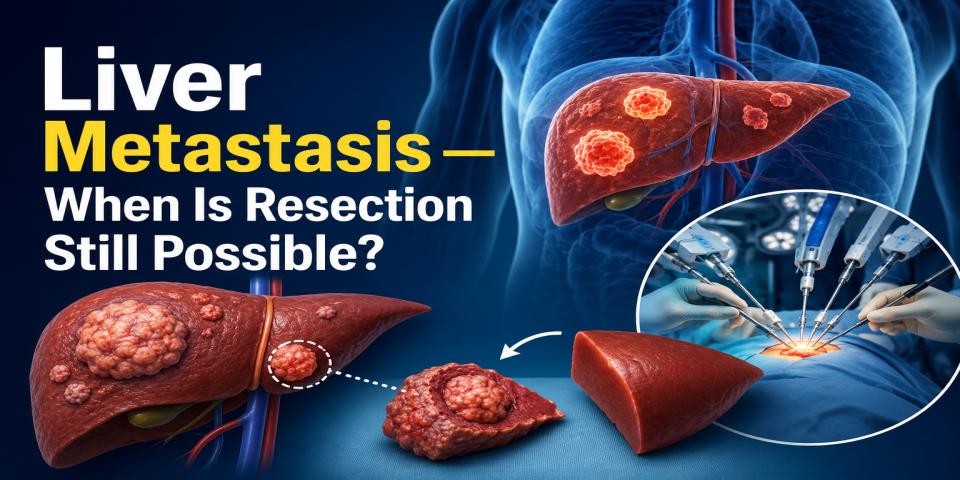
A liver metastasis diagnosis can feel overwhelming — but surgery is still a realistic option for many patients. Liver metastasis resection, when performed at the right time by an experienced HPB surgeon, offers the best chance of long-term survival and, in some cases, cure. The key question is not whether surgery is dangerous, but whether it is possible for your specific situation. This blog explains when liver metastasis resection is feasible, what determines eligibility, and what options exist when surgery is not immediately possible. If you are exploring liver metastasis treatment in Pune, this guide will help you ask the right questions at your next consultation.
What Is Liver Metastasis?
Liver metastasis — also called secondary liver cancer — occurs when cancer cells from another part of the body travel through the bloodstream or lymphatic system and form new tumours in the liver. It is different from primary liver cancer, which originates in the liver itself.
Secondary liver cancer treatment depends heavily on the original cancer type, the number and size of liver tumours, and how much healthy liver tissue remains. The liver is one of the most common sites for cancer to spread, which is why liver cancer treatment in Pune has become an increasingly critical area of HPB surgical care.
Which Cancers Commonly Spread to the Liver?
Several cancer types have a strong tendency to metastasise to the liver. The most common include:
- Colorectal cancer — the most frequent cause of liver metastasis, accounting for nearly 50% of cases
- Breast cancer
- Pancreatic cancer
- Stomach cancer
- Lung cancer
- Neuroendocrine tumours
- Ovarian cancer
- Melanoma
Colorectal cancer liver metastasis resection is the most studied and most commonly performed of all liver metastasis surgeries, with well-established survival data supporting aggressive surgical treatment in eligible patients.
What Is Liver Resection for Metastasis?
Liver resection for metastasis is a surgical procedure to remove the cancerous portions of the liver while leaving behind enough healthy liver tissue to sustain normal function. It is considered the gold standard of resectable liver metastasis treatment when the patient meets specific eligibility criteria.
Hepatic metastasis surgery involves removing one or more segments of the liver — a procedure that requires exceptional surgical precision because the liver has a complex network of blood vessels and bile ducts running through it. Liver tumour removal surgery in India has advanced significantly, with minimally invasive techniques now available at specialised HPB centres.
When Is Liver Resection Possible?
Liver metastasis resection is not suitable for every patient. Eligibility is determined by a combination of tumour-related and patient-related factors evaluated carefully before surgery is recommended.
Criteria That Make a Patient Eligible for Resection:
The following liver metastasis resection criteria indicate that surgery may be possible:
- The primary cancer (e.g. colorectal) has been or can be controlled.
- All liver metastases can be completely removed with clear margins.
- At least 20 to 30% of healthy liver tissue (future liver remnant) will remain after surgery.
- The patient is medically fit for a major surgical procedure.
- There is no uncontrolled spread to other organs that cannot be treated.
- Colorectal cancer liver metastasis resection is particularly well-supported — even patients with multiple liver metastases may be eligible if all deposits can be cleared.
What Makes a Patient Ineligible for Resection?
Surgery may not be immediately possible if:
- More than 70 to 80% of the liver is involved with the tumour.
- The future liver remnant is too small to sustain function after resection.
- The cancer has spread extensively to other organs beyond the liver.
- The patient has severe liver disease (cirrhosis), reducing overall liver reserve.
- The patient’s general health cannot withstand a major operation.
Ineligibility today does not always mean ineligibility forever — several strategies exist to convert unresectable cases into resectable ones.
How Is Resectability Determined?
The decision on whether liver metastasis resection is feasible is never made by one doctor alone. It requires a thorough multi-step evaluation.
1. Imaging and Staging:
High-quality imaging is the foundation of resectability assessment:
- CT scan (triphasic) — maps tumour number, size, and location within liver segments
- MRI liver with Primovist — detects small tumours missed on CT and assesses liver segment involvement
- PET-CT scan — identifies extrahepatic (outside the liver) disease that may affect surgical planning
- Volumetric CT assessment — calculates the size of the future liver remnant after planned resection
2. Liver Function Assessment:
Before any liver resection surgery in Pune, the functional capacity of the remaining liver must be evaluated:
- Blood tests — bilirubin, albumin, INR, liver enzymes
- Child-Pugh and MELD scoring for patients with underlying liver disease
- Indocyanine Green (ICG) clearance test for precise liver reserve measurement
3. MDT (Multidisciplinary Team) Evaluation:
Every liver metastasis case should be reviewed by a multidisciplinary team including:
- HPB surgeon
- Medical oncologist
- Radiologist
- Radiation oncologist
- Pathologist
This team-based review ensures the most accurate assessment of liver metastasis resection criteria and the most appropriate treatment plan for each individual patient.
What If the Liver Metastasis Is Not Resectable Right Now?
Not being resectable at the time of diagnosis does not mean the opportunity for surgery is lost. Several effective strategies exist for unresectable liver metastasis treatment that can convert a patient from inoperable to operable.
1. Downstaging with Chemotherapy:
Downstaging liver metastasis with chemotherapy involves using systemic drug treatment to shrink the liver tumours before surgery. This is one of the most commonly used strategies in colorectal liver metastasis cases.
- FOLFOX or FOLFIRI-based chemotherapy regimens are most commonly used
- Targeted agents such as Bevacizumab or Cetuximab may be added based on tumour genetics
- Reassessment imaging is done after 4 to 6 cycles to evaluate resectability
- Approximately 15 to 30% of initially unresectable patients become resectable after successful downstaging
2. Portal Vein Embolisation (PVE):
Portal vein embolisation for liver metastasis is a technique used when the future liver remnant is too small to be safe after resection. PVE works by blocking the blood supply to the side of the liver that will be removed, forcing the other side — the future remnant — to grow larger over 4 to 6 weeks. Once the remnant has grown sufficiently, surgery becomes safe to perform.
3. Ablation Therapy as an Alternative:
Liver metastasis ablation vs resection is an important comparison for patients who are not surgical candidates. Ablation techniques — including radiofrequency ablation (RFA) and microwave ablation (MWA) — destroy tumour cells using heat energy delivered through a needle guided by imaging.
- Ablation is best suited for small tumours (less than 3 cm) that are not near major blood vessels.
- It can be used alongside resection for tumours in areas that cannot be safely removed.
- Ablation does not require removal of liver tissue, making it suitable for patients with limited liver reserve.
- Long-term survival after ablation is generally lower than after resection for equivalent tumours, but it remains a valuable option for selected patients.
Surgical Approaches for Liver Metastasis Resection:
Once a patient is confirmed as resectable, the surgical team — led by an experienced HPB surgeon — selects the most appropriate technique based on tumour location, size, and the patient’s overall condition. Dr Manoj Dongare offers the full range of liver resection surgery in Pune using both open and minimally invasive approaches.
1. Open Liver Resection:
Open liver resection remains the most widely used approach for complex hepatic metastasis surgery. It provides the surgeon with direct access and the ability to feel the liver tissue, which is especially important when multiple tumours are present or when tumours are located near major vessels.
2. Laparoscopic Liver Resection:
Liver metastasis laparoscopic surgery in India is now available at specialised HPB centres for carefully selected patients. Benefits include:
- Smaller incisions and less blood loss
- Shorter hospital stay — typically 3 to 5 days
- Faster recovery and earlier return to chemotherapy if needed
- Equivalent oncological outcomes to open surgery in eligible cases
3. Two-Stage Hepatectomy:
Two-stage hepatectomy is a strategy used when the total volume of liver metastases is too large to remove safely in a single operation. In the first stage, metastases on one side of the liver are cleared, and portal vein embolisation may be performed to grow the opposite lobe. In the second stage — typically 6 to 8 weeks later — the remaining metastases on the other side are removed. This approach has made curative surgery possible for patients previously considered unresectable.
What Are the Outcomes After Liver Metastasis Surgery?
Liver metastasis surgery survival rate in India has improved significantly with advances in surgical technique, perioperative care, and combination treatment strategies.
Key outcome data for resected liver metastasis:
- 5-year survival rate after colorectal liver metastasis resection: 40 to 60%
- 10-year survival: approximately 20 to 25% — a figure previously considered impossible without surgery
- Operative mortality at experienced HPB centres: less than 2 to 3%
Metastatic cancer liver prognosis is significantly better after complete resection compared to chemotherapy alone. The liver metastasis prognosis after surgery depends on factors including the number of metastases, presence of extrahepatic disease, response to chemotherapy, and the completeness of surgical clearance. Liver surgery survival rate for metastasis continues to improve as more patients are considered for aggressive surgical management.
Liver Metastasis Treatment in Pune — Consult Dr. Manoj Dongare:
If you or a family member has been diagnosed with liver metastasis and want to understand whether surgery is still possible, the most important step is consulting an experienced HPB surgeon who specialises in complex liver surgery.
Dr. Manoj Dongare is one of the best liver cancer surgeons in Pune and a leading HPB and Liver Transplant Surgeon in Pune with extensive experience in liver metastasis resection, two-stage hepatectomy, laparoscopic liver surgery, and HPB surgery in Pune. Practicing at Cloverleaf Speciality Clinic, Wakad, Pune, Dr. Manoj Dongare offers a complete multidisciplinary approach to liver metastasis treatment in Pune — from resectability assessment and surgical planning to post-operative oncology support.
As a trusted cancer specialist in Pune PCMC and the best liver transplant surgeon in Pune, Dr. Manoj Dongare and his team evaluate every patient individually, with a focus on maximising the chance of surgical cure while maintaining safety.
Call: +91 9881379573
Book a consultation with Dr. Manoj Dongare today for expert guidance on liver metastasis treatment in Pune.
Frequently Asked Questions:
Yes, in many cases, liver metastasis can be surgically removed. Liver metastasis resection is the most effective treatment available and offers the best long-term survival outcomes. Eligibility depends on the number and location of tumours, the amount of healthy liver tissue remaining, the status of the primary cancer, and the patient’s overall health. A specialist HPB surgeon for liver metastasis in Pune can assess whether resection is possible after reviewing your imaging and reports.
The key liver metastasis resection criteria include: all tumours can be completely removed, at least 20 to 30% of healthy liver will remain after surgery, the primary cancer is controlled, and the patient is medically fit. Colorectal cancer liver metastasis resection is the most commonly performed and has the most established eligibility criteria in international guidelines.
The liver metastasis surgery survival rate in India varies by cancer type and stage. For colorectal liver metastasis, the 5-year survival rate after complete resection is 40 to 60%. Without surgery, median survival on chemotherapy alone is typically 18 to 24 months. Surgery offers the only realistic chance of long-term cure.
Unresectable liver metastasis treatment options include downstaging chemotherapy to shrink tumours, portal vein embolisation to grow the remaining liver before surgery, and ablation therapy for small tumours. Many patients who are initially inoperable become eligible for liver metastasis treatment in Pune after successful downstaging. Consulting an HPB surgeon early — rather than waiting — maximises the chances of converting to resectable status.
Yes. Liver metastasis laparoscopic surgery in India is now available at experienced HPB centres for selected patients. It is suitable for tumours in accessible liver segments and offers the benefits of smaller incisions, less blood loss, shorter hospital stay, and faster recovery. Not all patients are suitable — the decision is made after detailed imaging review by the surgical team.
There is no fixed upper limit on the number of metastases that can be removed. What matters is that all tumours can be completely cleared and that enough healthy liver — at least 20 to 30% — remains after resection. Patients with 4, 5, or even more metastases have undergone successful liver resection surgery in Pune when the distribution of tumours allowed safe clearance.
Liver metastasis ablation vs resection differs in the treatment approach. Resection physically removes the tumour-containing liver tissue and is the preferred option for eligible patients with the best long-term outcomes. Ablation destroys tumour cells in place using heat energy and is used for small tumours or as a complement to resection. When resection is feasible, it generally provides superior survival outcomes compared to ablation alone.
In selected patients — particularly those with colorectal liver metastasis — surgery can result in long-term cure. Approximately 20 to 25% of patients who undergo complete liver metastasis resection are alive at 10 years with no evidence of disease. This makes hepatic metastasis surgery one of the few treatments in oncology that can offer genuine curative intent for metastatic cancer.
Yes. At experienced HPB surgery centres in Pune, liver resection for metastasis carries an operative mortality of less than 2 to 3%. Advances in surgical technique, anaesthesia, and post-operative care have made liver surgery significantly safer over the last two decades. The risk is carefully weighed against the potential benefit of cure or prolonged survival for each individual patient.