
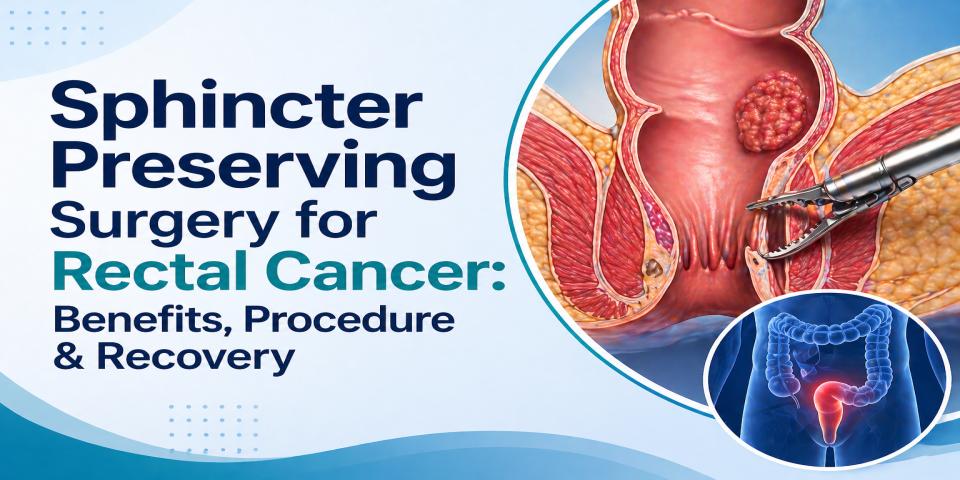
When diagnosed with rectal cancer, one of the biggest concerns patients have is whether they will need a permanent colostomy bag. The good news is that with modern surgical techniques, many patients can avoid this outcome. Dr. Manoj Dongare, a highly experienced oncosurgeon and rectal cancer surgeon with 17 years of experience, practising at Cloverleaf Speciality Clinic in Pune, specialises in sphincter-preserving surgery for Rectal Cancer. As a leading oncologist in Pune and colorectal cancer surgeon, he has helped hundreds of patients maintain their natural bowel function while achieving excellent cancer control outcomes.
What Is Sphincter Preserving Surgery?
Sphincter Preserving Surgery (SPS) is a surgical technique used to remove rectal cancer while keeping the anal sphincter muscles intact. The sphincter muscles are responsible for controlling bowel movements. In traditional rectal cancer surgeries, these muscles were often removed, requiring a permanent colostomy. Sphincter-preserving surgery changes this by allowing the surgeon to remove the cancerous tissue and reconnect the bowel, so the patient can pass stools naturally.
This surgery is also known as:
- Low Anterior Resection (LAR)
- Ultra-Low Anterior Resection
- Intersphincteric Resection (ISR)
- Coloanal Anastomosis
Why Sphincter Preservation Is Important?
Losing sphincter function has a major impact on a patient’s quality of life. A permanent stoma (colostomy bag) can cause emotional distress, lifestyle changes, and social discomfort. Sphincter preservation matters because:
- It allows patients to maintain natural bowel control
- It avoids the need for a permanent colostomy bag
- It significantly improves the patient’s emotional and social well-being
- It supports a faster return to daily normal activities
- It reduces the psychological burden associated with cancer treatment
For most patients, knowing they can live a near-normal life after surgery provides great mental relief during an already difficult time.
Who Is Eligible for Sphincter Preserving Surgery?
Not every rectal cancer patient is automatically a candidate for this surgery. Eligibility depends on several factors:
- Location of the tumour – Tumours in the upper or mid rectum are more suitable; even some low rectal tumours may qualify
- Stage of cancer – Early to intermediate stages are best suited.
- Size of the tumour – Smaller tumours have better outcomes with sphincter preservation
- Response to pre-surgery treatment – Patients who respond well to chemoradiation may become eligible even if they were not initially
- Overall health of the patient – General fitness and organ function matter for surgical suitability
- Sphincter muscle strength – If the sphincter muscles are already weakened, preservation may not give good functional results
A thorough evaluation by an expert laparoscopic cancer surgeon is essential to determine the right surgical approach.
Types of Sphincter Preserving Procedures:
There are different techniques available depending on the tumour’s location and size:
- Low Anterior Resection (LAR): Used for tumours in the upper and middle rectum. The rectum is removed and the colon is joined to the remaining rectum.
- Ultra-Low Anterior Resection: For tumours very close to the sphincter, the bowel is joined just above or at the sphincter level.
- Intersphincteric Resection (ISR): Part of the internal sphincter is removed along with the tumour, but the external sphincter is preserved. This is used for very low rectal tumours.
- Coloanal Anastomosis: The colon is directly connected to the anal canal after removing the entire rectum.
- Transanal Minimally Invasive Surgery (TAMIS): Used for early-stage rectal cancer, removing the tumour through the anus with minimal external incisions.
Step-by-Step Procedure of the Surgery:
Understanding what happens during the surgery helps patients feel more prepared and confident.
- Pre-operative Assessment: Complete blood tests, MRI, CT scan, and colonoscopy are done to map the tumour precisely.
- Neoadjuvant Therapy (if needed): Some patients receive chemotherapy and radiation before surgery to shrink the tumour and improve sphincter preservation chances.
- Anaesthesia: General anaesthesia is administered. The patient is completely asleep throughout the procedure.
- Surgical Approach: The surgery is performed laparoscopically (minimally invasive) in most cases. Small cuts are made in the abdomen through which a camera and instruments are inserted.
- Tumour Removal: The rectum, along with the cancer and surrounding lymph nodes (Total Mesorectal Excision or TME), is carefully removed while avoiding the sphincter muscles.
- Bowel Reconnection: The colon is joined to the remaining bowel or anal canal using surgical staplers or hand-sewn techniques.
- Temporary Stoma (if needed): In some cases, a temporary loop ileostomy is created to allow the join to heal. This is usually reversed after 8 to 12 weeks.
- Closure and Recovery: The incisions are closed, and the patient is moved to the recovery room.
Benefits of Sphincter Preserving Surgery:
This surgery offers significant advantages over traditional approaches:
- No Permanent Colostomy Bag: The most important benefit — patients maintain natural bowel movements without an external bag.
- Better Quality of Life: Patients report higher satisfaction in social, personal, and professional life after sphincter-preserving procedures.
- Minimally Invasive Option: When done laparoscopically, it means smaller cuts, less pain, less blood loss, and faster healing.
- Equal Cancer Control: Studies confirm that sphincter-preserving surgery offers the same cancer-free outcomes as more radical surgeries when performed correctly.
- Shorter Hospital Stay: Most patients are discharged within 5 to 7 days compared to longer stays with open surgeries.
- Faster Return to Normal Activities: Patients typically resume light activities within 3 to 4 weeks.
- Reduced Risk of Wound Complications: Laparoscopic techniques lower the risk of post-operative infections and hernias.
- Psychological Benefits: Patients experience less anxiety, depression, and body image issues compared to those with a permanent stoma.
Risks and Possible Complications:
Like any major surgery, sphincter preserving surgery carries some risks:
- Anastomotic Leak: The join between bowel segments may occasionally leak, which is the most serious complication. A temporary stoma helps reduce this risk.
- Bowel Function Changes: Some patients experience frequent bowel movements, urgency, or incomplete emptying — a condition called Low Anterior Resection Syndrome (LARS). This usually improves with time and therapy.
- Bleeding: Intraoperative or post-operative bleeding can occur, though it is rare with experienced surgeons.
- Infection: Risk of surgical site or intra-abdominal infection.
- Urinary or Sexual Dysfunction: Nerve damage during surgery can cause temporary bladder or sexual function changes.
- Cancer Recurrence: If margins are inadequate, local recurrence is a concern, which is why surgical expertise matters greatly.
Recovery After Surgery:
Recovery from sphincter preserving surgery involves several stages:
In the Hospital (Days 1–7):
- Pain is managed with medications.
- Patients are encouraged to walk within 24 hours of surgery.
- The liquid diet is started early and advanced gradually.
- Drain and catheter are removed over the first few days.
At Home (Weeks 1–6):
- A soft, easily digestible diet is recommended
- Avoid heavy lifting or strenuous activity
- Take all prescribed medications regularly
- Follow up with your surgical team as advised
- Watch for warning signs like fever, increased pain, or unusual discharge
Long-Term Recovery (Months 1–6):
- Bowel habits gradually normalise over several months
- Pelvic floor exercises help strengthen sphincter function
- Dietary adjustments may be needed initially
- If a temporary stoma was created, reversal surgery is planned at 8–12 weeks
- Regular oncology follow-up with scans is essential
When to Consult a Rectal Cancer Specialist?
You should seek evaluation from a specialist if you notice:
- Blood in stools lasting more than a few days
- Persistent change in bowel habits (constipation or loose stools)
- Unexplained weight loss
- Feeling of incomplete bowel emptying
- Abdominal pain or bloating without a clear cause
- A confirmed diagnosis of rectal cancer with questions about surgical options
Early consultation leads to better treatment options, including the possibility of sphincter preservation.
Why Dr. Manoj Dongare Is the Best Choice for Sphincter Preserving Surgery in Pune & PCMC?
When it comes to complex rectal cancer surgery, the surgeon’s experience and expertise directly affect the outcome. Dr. Manoj Dongare is widely regarded as the best oncosurgeon in Pune and PCMC for colorectal and rectal cancer surgery for the following reasons:
- 17 years of specialised surgical experience in cancer surgeries
- Expertise in laparoscopic cancer surgery, making procedures minimally invasive and recovery faster
- Trained in advanced Total Mesorectal Excision (TME) techniques critical for sphincter preservation
- Practices at Cloverleaf Speciality Clinic, Wakad, Pune are equipped with modern surgical infrastructure
- Patient-first approach with clear communication and personalised treatment planning
- Manages complex and low rectal tumours that other centres may deem inoperable for sphincter preservation
- Strong multidisciplinary team coordination with radiation oncologists and medical oncologists
Conclusion:
Sphincter Preserving Surgery for rectal cancer has truly transformed how patients experience treatment and recovery. It is no longer necessary for most rectal cancer patients to accept a permanent colostomy as their only option. With the right diagnosis, timely intervention, and an experienced colorectal cancer surgeon, preserving sphincter function is achievable for a large number of patients.
Dr. Manoj Dongare, one of Pune’s most trusted rectal cancer surgeons with 17 years of experience, has helped hundreds of patients successfully avoid a permanent colostomy bag through expert Sphincter Preserving Surgery at Cloverleaf Speciality Clinic, Wakad, and D.Y. Patil Hospital, Pimpri-Chinchwad.
If you or a loved one has been diagnosed with rectal cancer, do not delay seeking a second opinion from a qualified specialist to explore all available options. Book Consultation For Sphincter Preserving Surgery today and take the first step towards a better quality of life.
Call +91 9881379573 — Dr. Manoj Dongare, Pune.
FAQs:
Most patients recover fully within 6 to 8 weeks after sphincter preserving surgery. Hospital stay is typically 5 to 7 days. Light activities can resume in 3 to 4 weeks, while complete bowel function normalisation may take 3 to 6 months, especially after low anterior resections.
Some pain and discomfort are expected after the surgery, but they are well-managed with medications. When performed laparoscopically, the pain levels are significantly lower compared to open surgery. Most patients describe the post-operative discomfort as manageable and report that it reduces steadily within the first two weeks.
Sphincter Preserving Surgery has a high success rate when performed by an experienced rectal cancer surgeon. Studies show that it achieves the same cancer control results as radical surgery in appropriate candidates, with sphincter preservation successful in 70 to 90 percent of eligible patients. Long-term bowel function is satisfactory in the majority of cases, especially with proper post-operative rehabilitation and follow-up care.